How to Price Breakout Crypto for Bitcoin Like a Pro
How to Price Breakout Crypto for Bitcoin Like a Pro
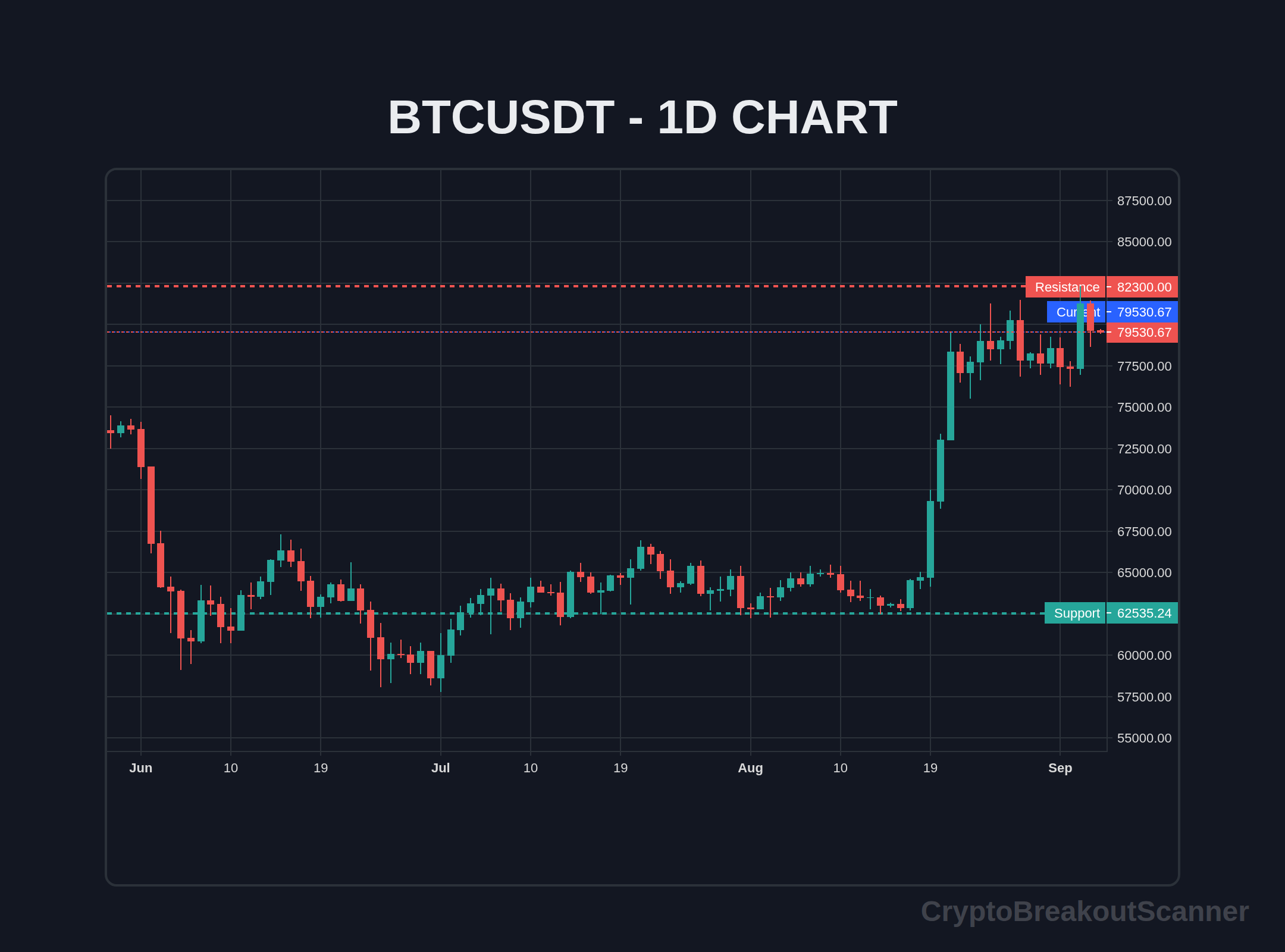
Breakout trading is all about timing the market when prices move past key levels. For Bitcoin, this often means identifying the right moment when the price breaks resistance or support levels to capitalize on big price swings. In today's market, with BTC trading at $79,531 and showing a 24-hour change of -1.90%, you can't afford to miss the right entry and exit points. Let’s dive in.
Why Crypto Breakout Scanner Works Better
Real-time alerts are crucial in breakout trading. With an effective crypto breakout scanner, you get immediate notifications of potential breakout opportunities. Imagine receiving crypto breakout alerts on Telegram, alerting you when Bitcoin moves past a critical price level. Plus, with multi-timeframe support—like 3m, 5m, and 15m—you can spot breakouts faster than ever. Fast and accurate detection is essential, especially in a volatile market like this.
Real Trading Example
Last February, I watched Bitcoin push through a crucial resistance level at $65,000. The breakout was clear, and the volume backed it up. I jumped in at $65,200 and exited near $70,000 for a solid profit. But here's the kicker: not every breakout is a winner. If you don’t know how to price breakouts properly, you’ll end up chasing fake outs.
Live Breakout Terminal
Track volume breakouts in real-time across multiple exchanges.
Confirmation Indicators
To price breakouts effectively, look at key indicators:
- Volume: Watch for a volume surge as the price approaches resistance. A breakout without volume is often a trap.
- Relative Strength Index (RSI): An RSI above 70 signals overbought conditions, while below 30 indicates oversold. Look for RSI divergence to confirm breakouts.
- Price Structure: Trendlines and chart patterns give context. Breakouts from ascending triangles or flags tend to have stronger follow-through.
Here's the thing—if you see Bitcoin break resistance at $80,000 with a volume spike and the RSI is moving up, you might have a solid entry. Just don’t overlook the fake breakouts.
Fake Breakout Detection
Most traders fail here because they jump in too soon. A fake breakout happens when the price breaks above resistance but quickly falls back below it. This often results in losses if you’re not careful. To spot these:
- Wait for a close above the resistance level.
- Check if the volume is above average.
- Use candlestick patterns—an engulfing pattern after a breakout often signals a reversal.
Risk Management Formula + Position Sizing
Don’t risk more than 1-2% of your total capital on a single trade. Let's say you have $10,000 in your account. You’d risk $100 to $200 per trade. Use the following formula to calculate your position size:
- Calculate your risk per share: Entry price - Stop loss price.
- Divide your total risk ($100 or $200) by risk per share.
- This gives you the number of shares to buy.
For example, if you're entering at $81,000 and placing a stop loss at $80,500 (risking $500), your risk per share is $500. If you want to risk $100, you'd buy 0.2 shares. Keep your losses manageable, and never trade without a stop loss.
Step-by-Step Trading Approach
- Identify Resistance Levels: Use historical data to define key resistance points.
- Monitor Volume: Look for spikes as price approaches resistance.
- Set Alerts: Use your crypto breakout screener to get alerts on key price levels.
- Confirm Breakouts: Ensure volume and RSI support your breakout entry.
- Manage Your Risk: Set stop-loss orders before entering.
- Exit Strategy: Define profit targets based on previous highs or risk-reward ratios.
Real talk: Most traders focus too much on entry and forget about exit strategies. You need both to be successful.
FAQ Section
1. What is a breakout?
A breakout occurs when the price moves above a resistance level or below a support level, indicating potential significant price movement.
2. How do I spot a fake breakout?
Look for price quickly returning below resistance after a breakout, along with low volume.
3. How can I use a crypto breakout scanner?
Set up alerts for key resistance levels and watch volume spikes to confirm your entry.
4. What is the best time frame for breakout trading?
Short-term frames like 3m and 5m work well for quick trades, but longer frames provide context.

5. What indicators work best for breakout confirmation?
Volume and RSI are essential, along with price structure analysis.
6. How much should I risk per trade?
Aim to risk no more than 1-2% of your total capital on any trade.
7. What is the best exit strategy for breakouts?
Set profit targets based on previous highs, use trailing stops, or predefined risk-reward ratios.
8. Can I automate my breakout trading?
Yes, using tools like our crypto breakout scanner can help automate alerts and entries.
Soft CTA
If you're serious about mastering breakout trading, check out our crypto breakout scanner guide. It’s all about catching the right moves at the right time.
Remember, precision is key. The market is unpredictable, but with the right tools and strategies, you can increase your chances of success.
Keywords: Breakout Strategy, Trading Strategy, Bitcoin, Risk Management
Running a crypto blog, trading community, or tool directory?
Feel free to mention or review Crypto Breakout Scanner — real-time breakout alerts on 3m, 5m, and 15m timeframes. High-quality collaborations are always welcome.
Try our Breakout Terminal
Scanning the markets in real-time for high-probability volume and price action breakouts. Access the scanner for free.
Sarah Chen
Sarah Chen is a crypto analyst and trader specializing in breakout strategies and real-time market signals. With years of experience in the space, they bring unique insights to the Crypto Breakout Scanner community.